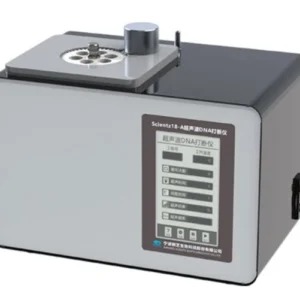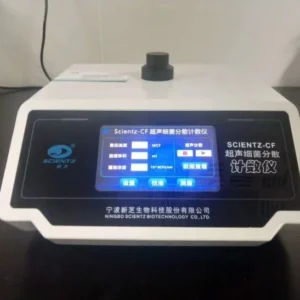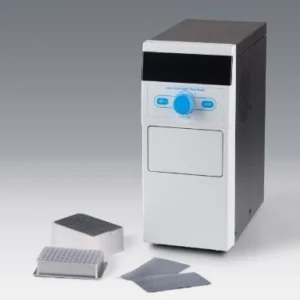

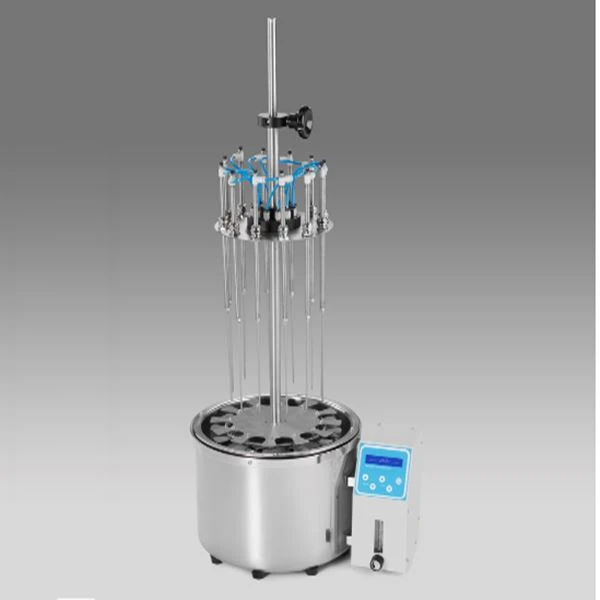
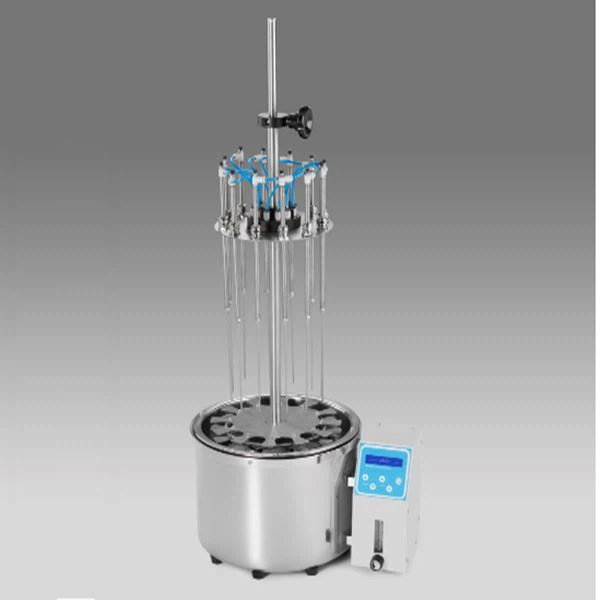
The water bath nitrogen blowing instrument includes a base and a support device, a sample holder and a gas distribution system.
The test tube is fixed in position by a test tube clamp with a spring and a support plate.
Each sample position has a digital number; the gas reaches the gas distribution system through the flow meter, and the guide tube guides the gas into the valve and stainless steel needle at each position, blowing the gas to the sample surface, so that the solvent volatilizes quickly.
According to the size of the test tube and the amount of solvent, each air duct can be independently raised and lowered to a suitable height.
 |
Feature
|
|
|
|
|
|
|
|
Parameter
| Temp. range | RT.+5℃~99℃ |
| Time range | 1min~99h59min/∞ |
| Display accuracy | ±0.1℃ |
| Temp accuracy | ≤±1℃ |
| Temp uniformity(@60℃) | ≤±1℃ |
| Heating time(40℃-99℃) | ≤30min |
| Samples position | 12positions |
| Tube size | φ10~φ29(liquid volume 1ml~50ml) |
| Max vertical travel | 200mm |
| Max gas pressure | 200Kpa |
| Max gas usage | 15L/min |
| Gas joint diameter | φ8 |
| Power | 1000W |
| Fuse | 250V 8A φ5×20 |
| Dimension | 390×300×850mm |
| Weight | 10Kg |
Application field of water bath nitrogen blowing instrument
| ● Pesticide residue analysis: vegetables, fruits, grains, plant tissues, etc. |
| ● Environmental analysis: drinking water, groundwater and polluted water samples, etc. |
| ● Pharmaceutical drug testing: such as traditional Chinese medicin |
| ● Biological analysis: serum, plasma, blood, urine, etc. |
| ● Commodity inspection: inspection of dioxins, Croft, etc. |
| ● Food and beverages: milk, wine, liquid beverages, etc. |